The Buck

Description
The black buck, and by extension the black brute, is characterized to be a hypersexual, primal, and savage African American who targets innocent people, especially white women. They were seen as less than human and more like animals who need to be put down or domesticated by white people.
Brief History
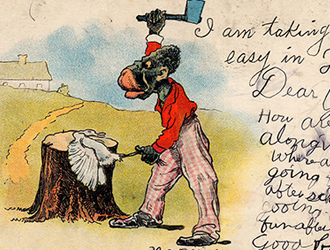
The initial description of the black buck/brute began in the Reconstruction era of America, where southern white men used such imagery as a way to justify the usage and continuation of slavery. In the words of the Jim Crow Museum, “During the Radical Reconstruction period (1867-1877), many white writers argued that without slavery — which supposedly suppressed their animalistic tendencies — black people were reverting to criminal savagery.” Through this depiction of African Americans as a savage animalistic creature, Southern white men created an image to which slavery and lynching was justified in the “taming” of these wild animals. They further justified their practices through the attribution of the raping of white women to African American men. As seen in Ida B. Wells’ Southern Horrors: Lynch Law in All Its Phases, the cases in which black men were lynched as a result of the false accusation of rape were numerous and many of their proponents used the crime as a justification to commit their acts of violence on the African American population. Through this depiction, black men were reduced to savages and would-be rapists within the general, white Southern populace and were perceived as lesser in terms of social standing. This degradation of the humanity of black men had essentially created a split between animals and humans, black men and white men. Through this dehumanization, a power structure was formed in which it was natural for violent repercussions and retribution to occur to black men; after all, it was only natural for violent, attacking beasts to be put down to protect oneself. A cage of discriminatory laws and biased courts was enacted to ensure that African Americans did not have the opportunity to enjoy or succeed in their post-Emancipation lives.
These public lynchings continued until the Civil Rights era where the power of the black buck/brute as justification weakened. As noted by the Jim Crow Museum, it is hard to display a person to be a savage animal when they are shown on television as being victims of police brutality and governmental oppression. While the cruelty depicted during the Civil Rights era made it difficult to justify the existence of black buck, many of its characteristics still persist to this day and evolved into different, yet similar stereotypes.
Ongoing Legacy and Contemporary Depiction
While the usage of the words “buck” or “brute” has lessened significantly in modern times, a new word has taken its place: the “thug”. The “thug” is often associated with crime, violence, and gang culture. While the animal connotations of the “brute” caricature have been erased, “thug” still carries the linkage of criminality and violence with black men, just like that of the “brute”. Much like the “brute”, the “thug” has been used as a way to exert power over African Americans and cut off support to them. As seen in the documentary The 13th, through the linkage between the drug epidemic of the 70s and the African American community, a mass incarceration system has been created that disproportionately arrests African Americans. Through this incarceration system, black men are essentially used as a source of free, cheap labor, much like that of slavery. With the perception of these black men as being “thugs”, little sympathy is offered to them, and they are, as a result, subject to cruel treatment that is seen as deserved and are powerless to prevent it. Thus, a power structure was constructed in which black men are seen as menaces to society and typically associated with crime, while white men have little stigma regarding criminality. Despite the evidence, as mentioned in The 13th, that white people were just as much participants in drug usage as black people, the perception created through the labeling of black men as “thugs” has benefited white people in lighter sentencing and greater leniency in punishment and persecution.
While the word “thug” might be considered to be okay to use in everyday life, the racism that lies within it is still the same as when one might use the “brute” to describe a black man back during the Reconstruction era. The only difference is that “thug” is more subtle and coded in comparison. In the words of Smiley and Fakunle, “Terms such as “thug,” “ghetto,” “hood,” “sketchy,” and “shady” are all examples of coded language that are used to refer to or speak of Blackness without overtly sounding racially prejudiced.” Coded language is words that sound neutral or okay to use, but are, in fact, laced with hidden meanings and symbolism. While popular media may use the word freely when describing black life, it nevertheless carries the negative connotations of being related to crime and drugs. It is not the most derogatory term used to describe African Americans; however, it still prescribes the idea that African Americans are criminals and thus lowers their social status as being less than everyday citizens. A power structure that lowers the lives of African Americans still exists, no matter how subtle it may be. In the end, although under a different name, the black brute caricature still exists within the modern U.S.A..
 African American Caricatures